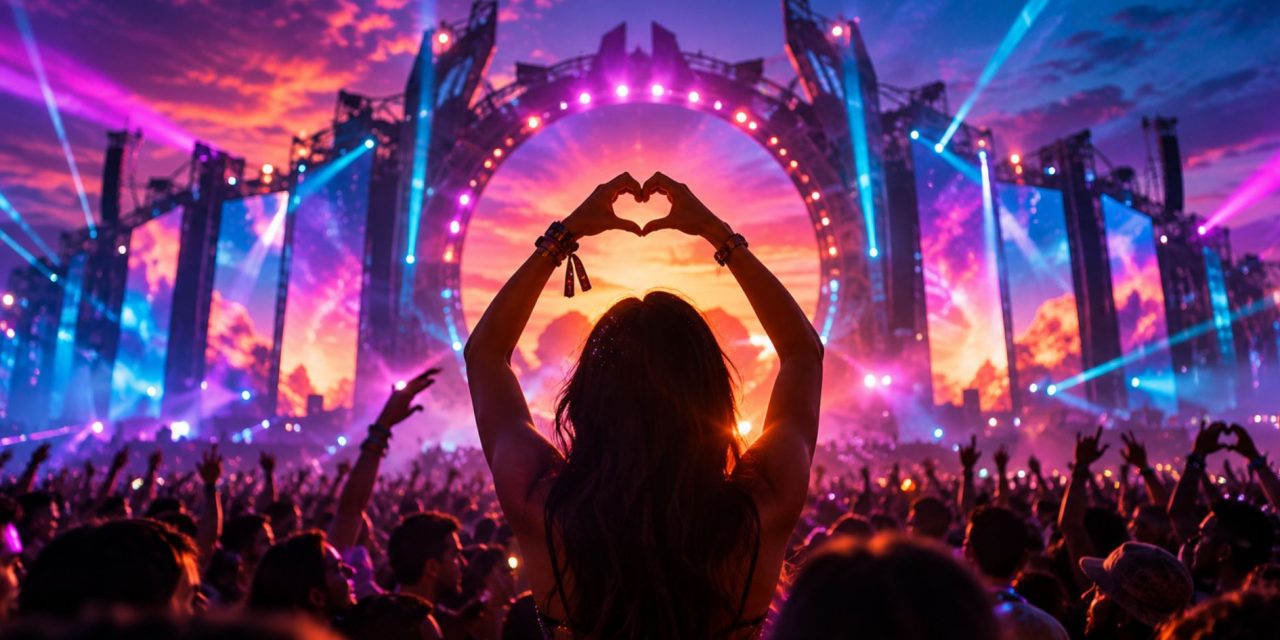
For a while, festival music seemed to have one simple instruction: build harder, drop bigger, and keep the energy moving. Then something interesting started happening.
A beautiful breakdown would arrive, the drums would disappear, and thousands of people would suddenly stop jumping long enough to sing, sway, or simply listen. Those quieter moments could become just as memorable as the biggest drops.
That raises an interesting question: are emotional EDM ballads finding their way back into the festival conversation?
Festival Programming Trends
Festival programming increasingly leaves room for contrast. A set filled with relentless high-energy tracks can eventually blur into one long wall of sound. An emotional track, placed carefully, can give the crowd somewhere else to go.
Sunset sets are an obvious place for this approach. The natural change from daylight to darkness already creates an emotional shift, giving melodic and atmospheric tracks room to breathe.
Headliner sets can use the same idea differently. A producer might strip the arrangement back after several heavy tracks, allowing vocals, piano, pads, or a spacious breakdown to take center stage before rebuilding the energy.
The original figures claiming specific numbers of “ballad moments” across Ultra, Tomorrowland, EDC Las Vegas, Coachella, and Lollapalooza would need event-by-event setlist verification. They should not be treated as established festival statistics without reliable sources.
What can be observed more broadly is the continued presence of melodic, atmospheric, and emotionally driven electronic music across major festival lineups.
Placement also varies. Some artists may use emotional material during sunset or late-night transitions, while others save it for a dramatic mid-set pause.
That flexibility matters.
The emotional track does not necessarily need to replace the festival banger. Sometimes its job is simply to make the next one hit harder.
Streaming Data
Streaming platforms tell a similar story, although their data needs careful interpretation.
Emotional electronic music continues to attract listeners across melodic house, progressive house, indie electronic, and related styles. Tracks built around memorable melodies and vocals can also have unusually long lives, appearing in playlists long after their initial release.
However, the specific Spotify and Beatport figures in the original version require source verification before being used as evidence of a market-wide comeback. Playlist additions, monthly listeners, and chart positions can fluctuate for many reasons, including editorial placement, algorithmic recommendations, artist popularity, and release timing.
There is still an important signal underneath all that data.
Listeners do not only use electronic music to chase energy.
They also reach for it when they want atmosphere, reflection, nostalgia, romance, escape, or that strange feeling of being somewhere else for four minutes.
Artists such as ODESZA, RÜFÜS DU SOL, and Lane 8 have built substantial audiences around electronic music that leaves room for melody, atmosphere, and emotional development.
That suggests emotional electronic music is not simply a festival intermission. For many listeners, it is the reason they press play in the first place.
Conclusion
The return of emotional EDM ballads is difficult to reduce to one chart position or festival statistic. Music programming is too varied, and listener behavior changes too quickly for a single number to tell the whole story.
But the appeal is easy to understand.
After an hour of heavy drops, sometimes the track that makes everyone stop is the one they remember.
That is the interesting space emotional EDM occupies. It can lower the pulse without losing the crowd, create intimacy without shrinking the room, and turn a festival moment into something surprisingly personal.
Have you ever been waiting for the next massive drop, only to realize the breakdown was the part you actually wanted to hear again? DLK Soulful EDM digs into the melodic, atmospheric, and emotional side of electronic music—and the moments that prove a track does not have to hit harder to hit deeper.
