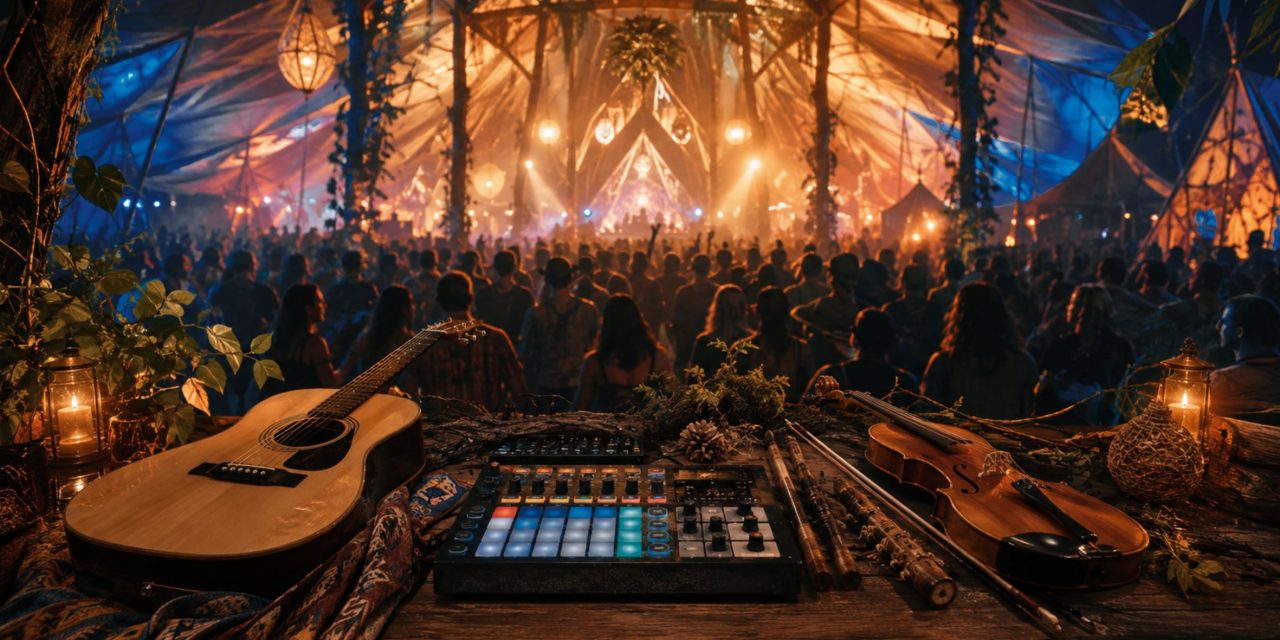
What happens when the warmth of folk music meets the pulse of electronic production? You get folktronica—a genre where acoustic instruments, storytelling vocals, and organic textures find new life alongside electronic beats and digital sound design.
Its story began taking shape in the late 1990s and early 2000s, as artists such as Four Tet, Caribou, Tunng, and The Books experimented with acoustic samples, live instruments, field recordings, and electronic production. What began as an unconventional meeting of two very different musical worlds gradually developed into a distinctive sound that could feel intimate enough for headphones yet rhythmic enough for the dance floor.
Origins of Folktronica
The folktronica history begins around the early 2000s, when artists started combining traditional acoustic instruments with increasingly accessible digital production.
Venues such as London’s Fabric and New York’s Knitting Factory became useful testing grounds for this emerging approach. Artists could bring acoustic guitars, live percussion, vocals, and other folk elements into environments increasingly shaped by drum machines, samplers, and electronic production.
The combination created an unusual contrast.
Folk music brought intimacy, narrative, and recognizable acoustic textures. Electronic production provided rhythm, repetition, and new possibilities for manipulating those sounds.
Acoustic guitar phrases could suddenly become rhythmic patterns. A vocal recorded in a quiet room could sit above a programmed beat. Field recordings could become part of the percussion.
Essentially, the music didn’t have to choose between the warmth of folk and the movement of electronic music. It could have both.
Early 2000s Experiments
Some of the defining experiments came from producers who treated acoustic recordings as raw material rather than finished performances.
Four Tet’s 2003 album Rounds became an important example of this approach, combining acoustic samples with electronically manipulated rhythms and textures.
Producers recorded acoustic instruments digitally before chopping, rearranging, and processing the recordings through samplers and software. Acoustic guitar phrases could be broken into small sections and rebuilt into rhythmic patterns.
The technology changed the relationship between the musician and the instrument without necessarily sacrificing its authenticity. Instead of simply recording a guitar and placing it over a beat, producers could manipulate individual notes, reverse phrases, change their timing, or use them as rhythmic building blocks.
Yet the organic character of the original recording often remained audible. That balance became one of folktronica’s defining characteristics.
Production could be highly digital while the source material still sounded unmistakably human.
Field recordings added another layer to the developing sound. Natural environments, everyday noises, and other found sounds could be incorporated alongside acoustic instruments, creating atmospheric arrangements that felt connected to the physical world.
The result was electronic music that did not sound entirely electronic.
Key Pioneering Artists
Several artists helped establish the sound during this early period.
Caribou, then recording as Manitoba, explored the relationship between live instrumentation and electronic production on releases including Up in Flames (2003). Acoustic guitars, percussion, and other live recordings were processed and layered into dense electronic arrangements.
Tunng developed another side of the sound by combining acoustic guitar, banjo, vocal harmonies, and electronic textures. Their music retained the storytelling qualities of folk while using digital production to create unusual atmospheres around those songs.
Psapp took an even more unconventional approach.
Their recordings incorporated toy instruments, household objects, and found sounds alongside electronic elements. Ordinary noises could become percussion, while unusual acoustic textures became part of the musical arrangement.
Four Tet’s Rounds and the work of The Books similarly demonstrated how acoustic instruments and found audio could be manipulated into intricate electronic compositions.
These artists did not all sound alike, and that was part of the point.
There was no single formula for folktronica. Instead, the emerging genre became a space where producers could experiment with acoustic storytelling, electronic rhythm, sampling, and unconventional sound design.
From Experiment to Festival Sound
As these techniques developed, folktronica began moving beyond the small venues and experimental scenes where much of its early work had emerged.
Festival audiences offered a different challenge.
The music needed enough rhythmic momentum to work in a large space while retaining the intimacy that made its acoustic elements distinctive.
Producers responded by giving acoustic instruments a stronger rhythmic role. Guitar patterns could become looping hooks, vocal harmonies could sit above electronic grooves, and organic percussion could reinforce programmed drums. This helped the sound move naturally into dance-oriented settings.
The dance tent became an especially fitting environment because it allowed artists to blur the boundary between a folk performance and an electronic set.
A singer with an acoustic guitar could become part of a much larger electronic arrangement. A banjo riff could become a dance hook. A field recording could become the texture underneath a festival-sized chorus.
The genre’s appeal came from that tension between the familiar and the unexpected.
Why the Fusion Lasted
Folktronica has remained interesting because neither side of the equation has to disappear.
The acoustic elements provide storytelling, imperfections, warmth, and emotional familiarity. Electronic production provides scale, rhythm, repetition, and almost limitless opportunities for transformation.
That makes the genre remarkably adaptable.
A song can begin with a voice and guitar before gradually introducing programmed percussion. A traditional folk melody can become a looping electronic motif. A field recording can quietly shape an entire arrangement without the listener even realizing where the texture came from.
The technology may continue changing, but the basic creative idea behind this fusion remains surprisingly simple: take something human, give it a beat, and see where it goes.
Conclusion
The history of folktronica is really a history of musicians refusing to keep acoustic and electronic music in separate rooms.
What began with early-2000s experiments involving guitars, samplers, field recordings, and digital effects developed into a distinctive musical language. Pioneers such as Four Tet, Caribou, Tunng, Psapp, and The Books demonstrated that folk’s storytelling qualities could survive—and even thrive—inside electronic production.
That is why the folktronica wave has lasted.
The instruments may be centuries old. The production tools may be completely modern. Somehow, they still know how to dance together.
So, is a banjo allowed in the dance tent now, or do we need to have a meeting about this? 😂 Explore more genre-bending sounds at DLK Soulful EDM.
