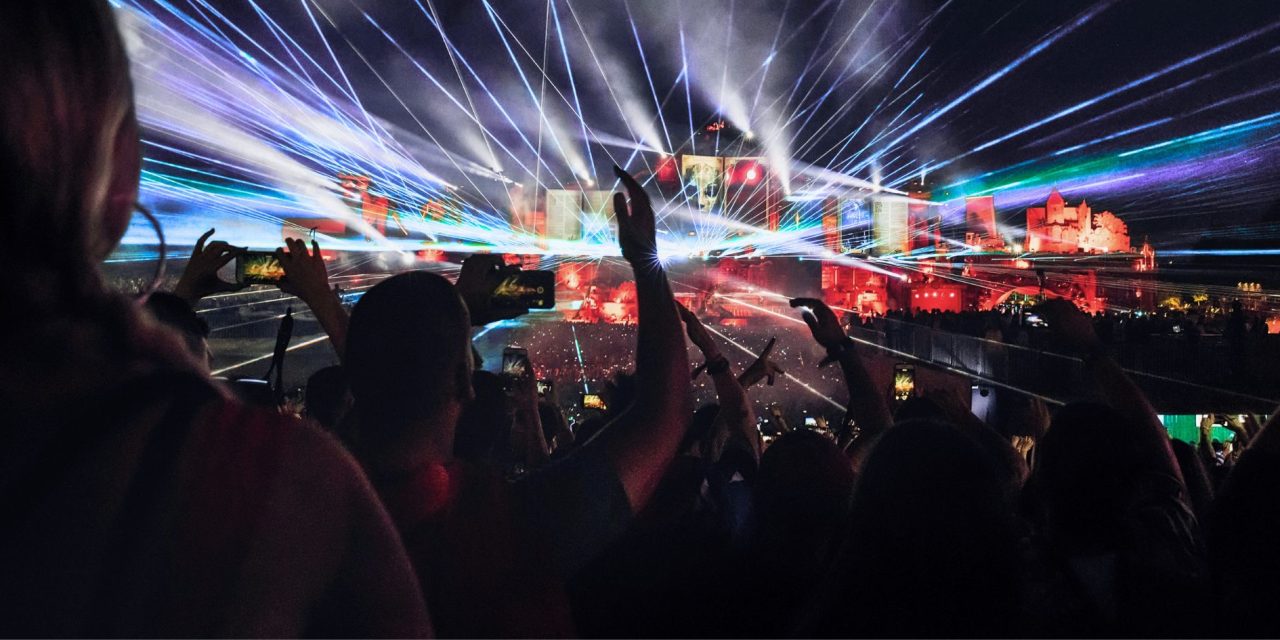
EDM has never been shy about spectacle. But sometimes, the most powerful festival moment comes when the production knows exactly when to pull back.
As melodic and emotional sounds continue finding their place on major stages, visuals are becoming more closely connected to the music. Lasers can rise with a build, screens can expand around a crowd, and real-time visuals can change as the performance develops.
These production choices can make euphoric moments feel even bigger without simply turning up the volume. The interesting part is how technology is increasingly being used to support the emotion already sitting inside the music.
Four Production Shifts Changing the Festival Experience
Festival production is becoming more closely tied to musical movement. Instead of treating lights, screens, and effects as separate decoration, designers can use them to reinforce rhythm, melody, atmosphere, and anticipation.
Four developments stand out: laser systems responding to musical builds, increasingly immersive stage designs, new approaches to bringing vocal performances into visual spaces, and real-time visual systems that can react during a show.
The technology behind these ideas can be sophisticated. The creative goal, however, is surprisingly simple: make the audience feel more connected to the moment.
Laser Light Mapping Synced to Melodic Builds
Lasers can do much more than flash across a crowd at maximum intensity. When carefully programmed, they can follow the shape of a melodic build and make its gradual rise visible.
A quieter section might use restrained beams and slower movement. As the melody develops, the lighting can widen and become more active before reaching the drop.
This creates a visual sense of anticipation that mirrors what listeners are already hearing. Instead of competing with the music, the lasers become another way of communicating its progression.
Modern show-control systems make this kind of synchronization increasingly flexible. Platforms such as Resolume can connect audio analysis with lighting and visual control, while DMX allows lighting systems to respond to programmed cues.
For melodic EDM, that can be especially effective. The build does not just sound like it is going somewhere; the entire stage appears to be moving with it.
Holographic and Extended Vocal Experiences
Vocal performances have always carried a strong emotional connection with electronic music. Technology is now giving artists and production teams more ways to represent those voices visually.
Holographic and projection-based performances can create the impression of performers appearing within the stage environment. Other productions use large-scale video, augmented visual elements, or digital characters to extend the identity of a vocalist beyond a conventional screen.
The idea is less about replacing a live singer and more about changing how vocals occupy the stage. A vocal hook can become part of the visual storytelling rather than simply another element in the audio mix.
This approach can work particularly well during emotional peaks. When a vocal phrase returns alongside a carefully timed visual, the audience receives the same musical idea through both sound and sight.
However, the effect depends heavily on restraint. If the visual technology becomes more interesting than the performance itself, the emotional connection can disappear beneath the spectacle.
360-Degree Immersive Stages
Traditional festival stages give audiences a clear focal point. Immersive designs can make that relationship much less straightforward.
Screens, lighting, projections, and other visual elements can surround parts of the audience, creating the impression that the performance extends beyond the stage itself.
This can be particularly useful for melodic EDM because the music often relies on gradual development. A surrounding visual environment can grow with the arrangement rather than forcing every musical moment into the same visual format.
The result can feel both massive and personal. Thousands of people may be watching the same show, yet the surrounding visuals can make the experience feel as though the music has taken over the entire space.
Immersive production also gives designers more opportunities to create contrast. A stage can feel almost empty during an atmospheric passage before suddenly expanding when the track reaches its emotional peak.
That contrast can make the payoff feel stronger than constant visual intensity ever could.
AI-Reactive Visuals Adapting in Real Time
Real-time visual technology introduces another possibility: performances that can change while they are happening.
Audio-reactive systems can already respond to characteristics of incoming sound. More advanced setups can combine audio, cameras, programmed effects, and generative visuals to create constantly changing environments.
Resolume, for example, supports audio analysis, BPM synchronization, MIDI, OSC, and DMX control for connecting visual performance with other systems.
AI can add another layer by helping generate or modify visual content in response to inputs. The most interesting use is not necessarily making everything unpredictable. It is allowing visuals to respond to the character of a performance instead of following exactly the same sequence every night.
Imagine a melodic section where the visuals remain restrained because the music is building slowly. When the crowd reaches a peak alongside the drop, the visual environment can respond with greater movement and intensity.
That creates the feeling that the show is happening with the audience rather than simply being presented to them.
When Technology Serves the Feeling
The common thread between these production approaches is not the technology itself. It is timing.
A laser system can be impressive, but it becomes more meaningful when it arrives at exactly the moment a melody opens up. A giant screen can look spectacular, but it becomes memorable when its movement supports the emotional direction of the music.
The same principle applies to immersive stages and real-time visuals. More technology does not automatically create more emotion.
Sometimes, the smartest production decision is knowing when not to use everything available.
That matters for melodic EDM because these tracks often depend on anticipation and release. Giving every section the same visual treatment can flatten that journey.
The production needs its own dynamics. Quiet moments should have somewhere to go, and emotional peaks should feel earned.
Conclusion
Technology is giving EDM producers and festival designers more ways to turn musical emotion into a physical experience. Lasers, immersive stages, visual performances, and real-time systems can all make a melodic moment feel larger when they are used with purpose.
The strongest festival productions are therefore not necessarily the ones with the most effects. They are the ones that understand the music well enough to know when a visual should explode, when it should move gently, and when the audience simply needs space to take in the moment.
That is where technology becomes genuinely useful. It stops being a collection of impressive tricks and becomes another instrument in the performance.
Ever had a festival moment where the lights, visuals, and music all hit at exactly the right time? DLK Soulful EDM looks at what goes into creating those moments and why the right production can make a track feel even more powerful.
