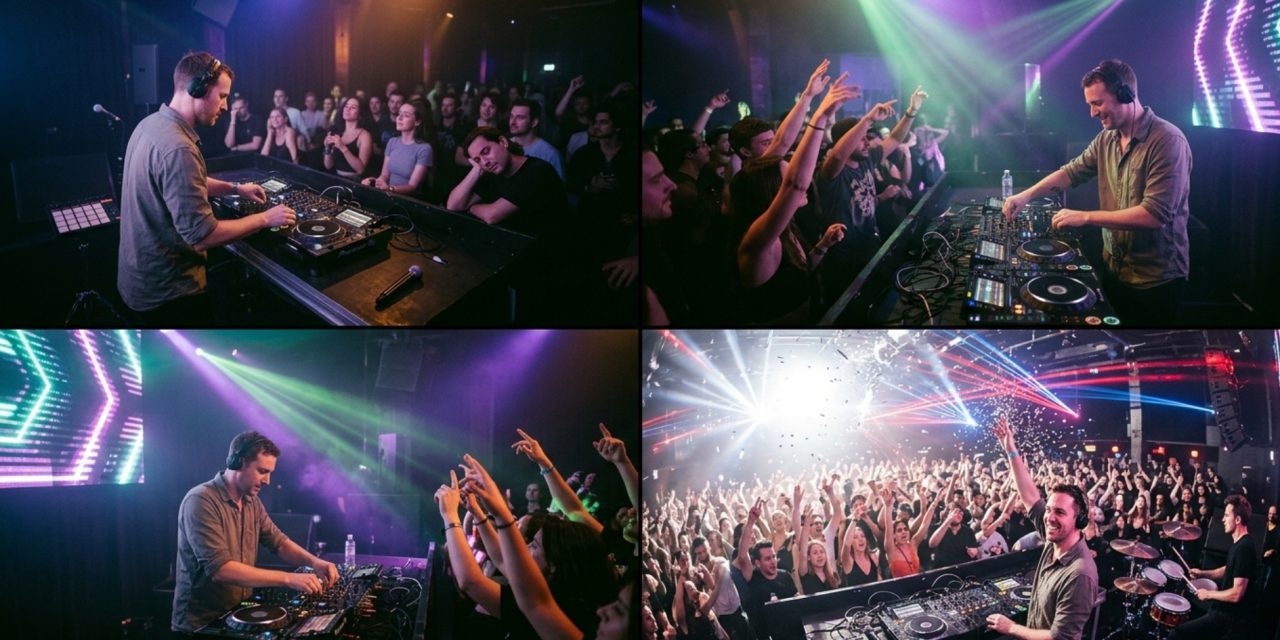
Understanding Chill-to-Dance transitions is one thing—but seeing how they actually play out in real sets is where the real insight lives. The theory gives you the blueprint, but the execution reveals the artistry. When top EDM DJs move from mellow grooves into full dancefloor energy, it’s never accidental.
Every transition, every buildup, every track choice is carefully placed to guide the crowd without breaking the flow. And when it’s done right, the shift doesn’t feel forced—it feels like the only direction the music could go.
Notable DJs and Their Approaches
Artists like Bonobo and Lane 8 are known for turning sets into experiences rather than just playlists. They don’t rush the energy—they build it, layer by layer.
Bonobo, for instance, carefully selects tracks like Kiara and Bambro Koyo Ganda to create a balance between organic instrumentation and electronic textures. His transitions feel natural, almost like the music is evolving on its own. By blending live-sounding elements with subtle beats, he creates a space where listeners can ease into the rhythm before the energy fully lifts.
Lane 8 takes a slightly different approach, focusing heavily on emotional progression. Tracks like Atlas and his remixes of Fort Romeau build slowly, using gradual crescendos to guide the audience from introspection to movement. His sets feel like a journey, where every transition is intentional and every rise in energy feels earned.
Both artists rely on tight beat matching and harmonic mixing, ensuring that each track flows seamlessly into the next. The result is a cohesive experience that keeps the audience connected from the first note to the final drop.
Analysis of Memorable Performances
Some performances go beyond good—they stay with you long after the music stops. A standout example is Anderson .Paak’s set at Coachella, where genre blending played a huge role in shaping the experience.
He moved effortlessly between hip-hop, funk, and jazz, layering soulful grooves with high-energy rhythms that kept the crowd fully engaged. The transitions didn’t feel forced—they felt like a natural progression, pulling the audience deeper into the set.
What made it even more impactful was the use of live instrumentation. Drums, vocals, and organic elements added depth and authenticity, making the performance feel alive rather than programmed. The crowd responded instantly, feeding off the energy and turning the set into a shared moment rather than just a show.
This kind of performance highlights what makes chill-to-dance transitions so powerful. It’s not just about increasing tempo—it’s about building a connection, guiding emotion, and knowing exactly when to let the energy peak.
Conclusion
Chill to dance sets showcase the true artistry of EDM performance. They require patience, precision, and a deep understanding of how music affects people in real time.
By carefully blending genres, controlling energy, and creating emotional flow, DJs can transform a set into a full experience—one that starts quietly and ends in unforgettable moments. It’s this journey that keeps audiences coming back for more.
You know that moment when a set slowly builds and suddenly you realize you’re fully locked in—no distractions, just the music?
Stay tapped into those perfectly crafted journeys and discover more sounds that move with intention only on DLK Soulful EDM.
