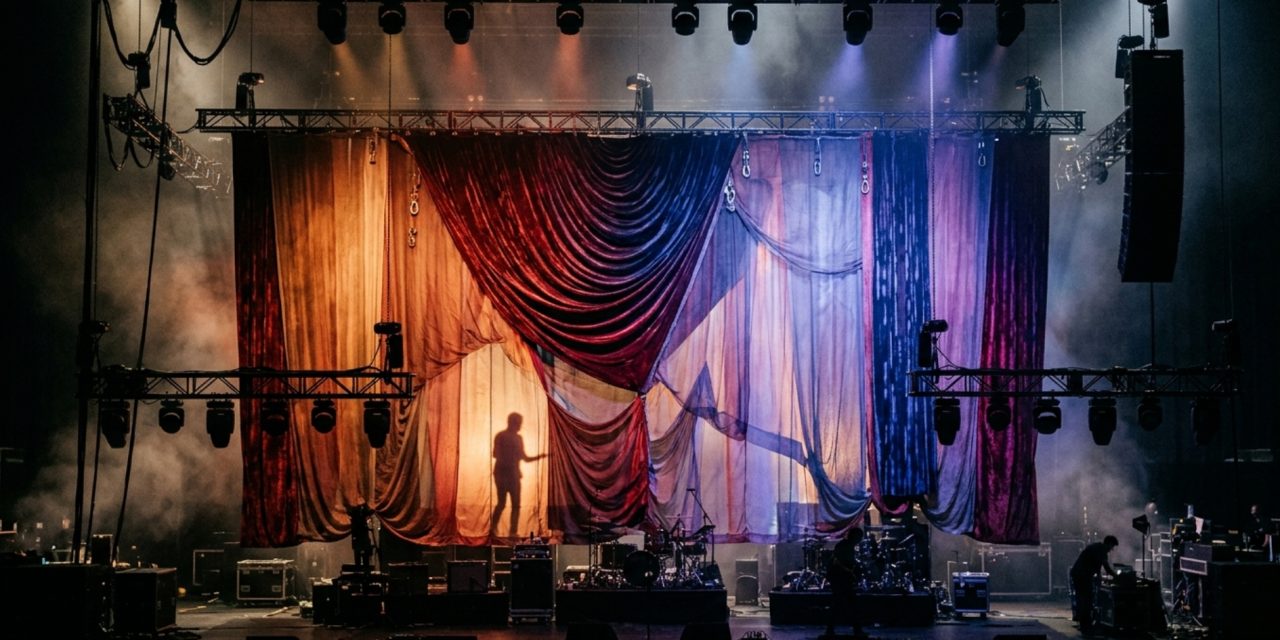
A stage drop might look like a background—but in reality, it behaves more like a silent performer.
When it’s done right, no one points it out… yet everyone feels it. The mood lands faster, the story feels clearer, and the performance suddenly has a world to exist in. When it’s done poorly, though, even the strongest performance can feel slightly disconnected—like the visuals and the music never quite agreed on the same idea.
That’s why designing an effective stage drop isn’t just about making something that looks good. It’s about creating something that supports emotion, enhances storytelling, and works seamlessly within the technical realities of a live production.
Artistic Considerations: Designing for Emotion and Narrative
At its core, stage drop design begins with feeling.
Color, texture, and theme aren’t just visual choices—they’re emotional cues that guide how an audience interprets a performance. Warm tones, for example, naturally introduce energy and intensity, making them ideal for high-impact or celebratory moments. Cooler tones, on the other hand, tend to slow things down, creating space for reflection or intimacy.
Texture adds another layer of meaning. A heavier fabric like velvet can introduce depth and richness, reinforcing a more dramatic or luxurious atmosphere. In contrast, lighter or sheer materials allow light to pass through, creating a softer, more fluid visual that works well for ambient or emotionally driven performances—especially in genres like soulful EDM, where mood plays a central role.
Theme ties everything together. A stage drop should never feel random; it should align with the narrative of the performance. A darker, more minimal design might suit a reflective set, while vibrant, layered visuals can elevate something more energetic or celebratory.
Tools like Adobe Illustrator make it easier to experiment with these elements before anything is physically produced. Designers can test color relationships, simulate textures, and refine concepts in a way that ensures the final piece feels intentional rather than improvised.
Technical Specifications: Where Creativity Meets Reality
As important as the artistic vision is, a stage drop ultimately has to function within real-world constraints.
Dimensions are the first consideration. A drop needs to properly frame the stage without leaving awkward gaps, which typically means allowing a slight overlap beyond the visible performance area. This ensures a clean visual presentation from different audience angles.
Weight is equally critical. Materials must be chosen not just for their appearance, but for their compatibility with the rigging system. Overloading a system doesn’t just risk the design—it compromises safety. That’s why understanding load limits and distributing weight correctly is a fundamental part of the process.
Mounting methods also play a key role. Hardware such as D-rings and carabiners must be suited for the load and compatible with existing structures like trusses or beams. When these elements are aligned properly, installation becomes smooth, stable, and reliable throughout the performance.
Venues like Royal Opera House demonstrate how precision in these technical details supports world-class productions. Behind every seamless visual is a system that has been carefully measured, tested, and executed.
Conclusion
Designing a stage drop is ultimately about balance.
It’s where creativity meets structure, where artistic vision is shaped by physical limitations, and where visual design becomes an extension of the performance itself. When both sides are handled with care, the result is something that doesn’t just decorate the stage—it enhances the entire experience.
In spaces like soulful EDM festivals and live shows, where emotion and atmosphere matter just as much as sound, that kind of visual support becomes essential.
Because sometimes, the difference between a good performance and an unforgettable one…
isn’t just what you hear—it’s what you see working in harmony with it.
What’s one live performance where the visuals completely elevated the music for you—and made the whole experience feel unforgettable?
Share it in the comments and stay inspired with more performance and production insights only on DLK Soulful EDM!
